In 2019, Kim Hyuk Gun (김혁건), the vocalist of THE CROSS (더크로스), gathered "other elements of vocal education" separately at the end of the vocal-education section of his doctoral dissertation. The title of one of those items is a short command: "Sing with your breath."
This is the twenty-third part of the series. It sets out that item together with muscle relaxation, confidence, character and effort, and the singer's body care — passages that treat singing not as technique alone but as the work of the whole body and mind.
01.Sing with Your Breath
The dissertation explains the sound made using resonance like this.
| The dissertation's explanation | |
|---|---|
| The candle | When you sing using resonance, however loud the sound, a candle in front of the mouth does not go out |
| Breath | All the breath must turn into sound and not be wasted; draw the breath out like a taut thread |
| Loudness | To sing loud you must use resonance, and must not force the throat |
| Dynamics | Forcing the throat makes crescendo and decrescendo impossible. Control the loudness of a note and express emotion with resonance |
| Range | If you turn the breath into resonance to make sound, you can control it freely from a very soft sound to a very loud one |
García's candle seen in Part 20 — a fine singer can hold a candle in front of the mouth without the flame flickering — appears here again. The breath does not leak out; it becomes sound. Crescendo and decrescendo are also the last row of the singing practice table in Part 21.
02.When Force Goes into the Throat: "Ha" Instead of "A"
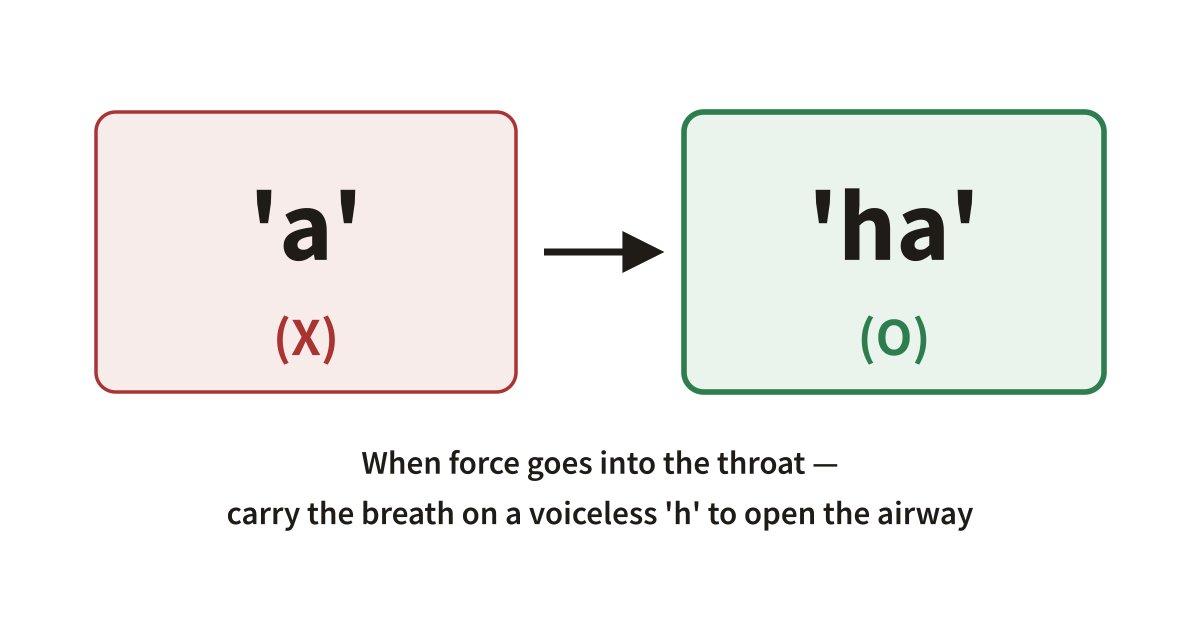
For the in-gola state, when force goes into the throat (Part 6, section 05), the dissertation writes one remedy: to release the force and open the airway, sing with the breath carried by a voiceless "h."
| "a" (X) | A sound sung straight out with force in the throat |
| "ha" (O) | A sound sung by first carrying the breath with a voiceless "h" — a sound made without vibrating the vocal folds |
A footnote in the dissertation explains a voiceless sound as "a sound made without vibrating the vocal folds." The breath flows first, and the sound rides on top of it.
03.Not Letting Go of Force, but Controlling It
The dissertation gives "muscle relaxation" an item of its own. In vocal technique, tensing, concentrating and applying force matter, but settling and releasing tension also matter a great deal.
| The dissertation's explanation | |
|---|---|
| Muscles around the neck | You must know how to relax them very comfortably |
| Control of force | Not releasing all force and tension, but keeping an appropriate state |
| Two problems | Not applying force is a problem, and applying too much force is a problem too |
| Excess | Applying excess force while lowering the tongue root and larynx puts force into the throat and the sound turns stiff. Excessive force always makes the sound unnatural |
| Head voice | Trying to produce head voice by forcing the throat is not the right way |
| Remedy | A natural balance of abdominal pressure and the vocal folds, and turning the sound round with the muscles of the whole body relaxed |
| High notes | The higher you go, the more the cricothyroid pulls the vocal folds long, tensing them taut and strong like a rubber band |
The body is released, and the vocal folds are stretched as much as needed. Why vibrato turns stiff when force is not controlled is in Part 16.
04.Confidence and Character
The dissertation includes matters of the mind among the elements of vocal education.
Confidence. Quoting Pavarotti — if we feel exactly the mood and heart Caruso felt when he sang, we too can make a sound like Caruso's — the dissertation writes that when you sing with confidence, upright posture and poise, the audience receives that emotion. Singing is an art that conveys thoughts and feelings through melody and lyrics, and if you sing without strength, shrinking in a cowed posture, the audience feels it keenly. So confidence too is an element to be trained, and singing in situations similar to those where you must perform, or singing in front of people, to keep from shrinking or tensing the body, should also be part of vocal practice, it concludes.
Character and effort. The dissertation likens a singer's voice to a mirror of the heart, writing that a right sound comes from right posture and attitude and that you can have as good a sound as the effort you put in. Because singing education is also a process of setting a goal and striving toward it, it adds, continuing to strive to overcome difficulties should be part of practice.
05.The Singer's Body Care
The dissertation writes that because the voice is the most basic instrument given to people, keeping a healthy body is like an instrumentalist keeping their instrument in its best condition. And it names three things as the singer's body care.
| Item | The dissertation's explanation (within the scope this series covers) |
|---|---|
| Wet sauna (the wet-compress method) | Names a sauna heated with water and a heater, and the wet-compress method of breathing through a dampened gauze towel held to the mouth, as care methods for singers |
| Strength training | Sit-ups and leg raises do not directly help singing. The force of lowering the diaphragm while singing, the force of raising it against the resistance of the vocal folds, and the force of the chest muscles that send the breath out strongly are strengthened when you practice singing |
| Aerobic exercise | Names aerobic exercise such as running and jumping rope as the basis of keeping up stamina |
The explanation of strength training stands out: the strength singing needs is built when you practice singing. The dissertation's note "with the wet-compress method and plenty of rest" in the staccato practice of Part 7 connects to this item too.
06.Today's Practice
Turned into points to check while you practice, what the dissertation and the lesson highlight looks like this.
- "Ha" instead of "a" — If force goes into your throat, carry the breath with a voiceless "h" and sing "ha" to open the airway (section 02; dissertation p.175).
- Crescendo and decrescendo on one note — Without forcing the throat, sing one note gradually louder and gradually softer with resonance (section 01; dissertation pp.175, 170).
- Sing in front of people — Singing in a setting similar to where you must perform is also part of vocal practice (section 04; dissertation pp.173–174).
- Compare with the true vocal folds together — Lesson Season 2 Ep. 16 (Shout Technique) compares sound made with the true vocal folds brought together, with staccato and resonance, against using only the false vocal folds (video description).
The lesson to watch with this part is Season 2, Episode 16, "Shout Technique." Its description lists shout = belting it out, singing with the true vocal folds together using staccato and resonance, and a comparison with using only the false vocal folds. The true vocal folds and staccato are in Part 7.
07.Where to Go Next
Consonants and vowels are in Part 22 · Diction, and the last part, which bundles the whole series into a practice routine and sets out the experimental results, is Part 24 · Practice Routine and Experimental Results. THE CROSS Band's rock stages can be heard in THE CROSS Band's Rock Covers. Lesson videos are in Korean.
The breath like a taut thread — and that thread becomes sound to the very end.