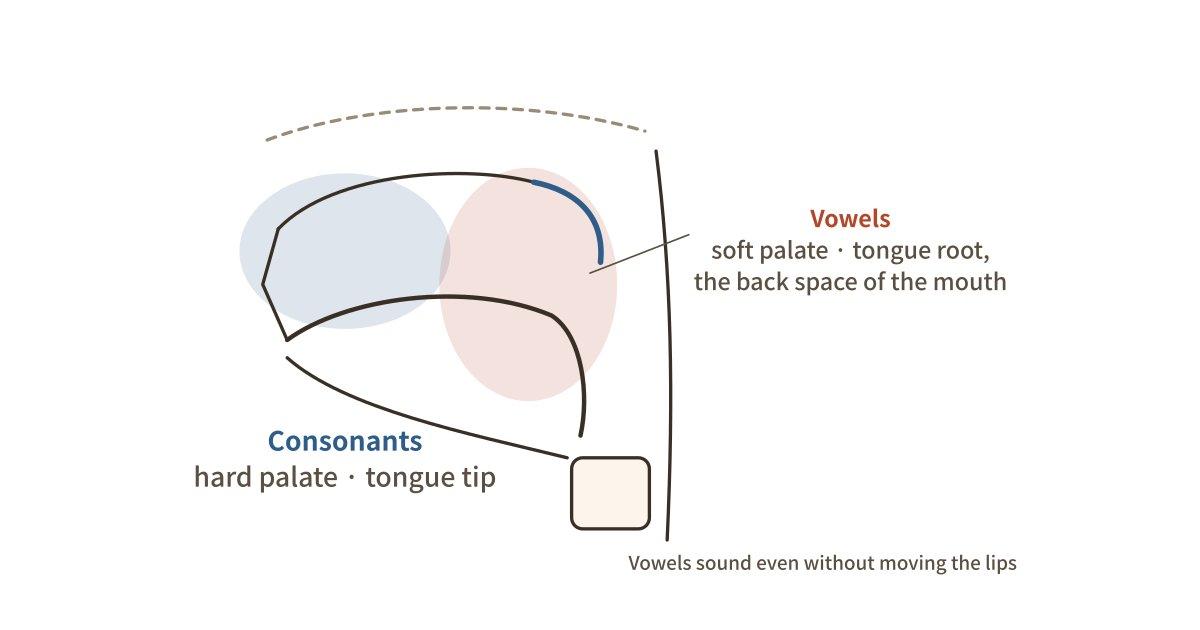
In 2019, Kim Hyuk Gun (김혁건), the vocalist of THE CROSS (더크로스), made the fourth session of his doctoral dissertation's experimental lessons "nasal resonance and correcting pronunciation," covering lessons 2-3 "How to sing with nasal resonance" and 2-5 "Correcting pronunciation" together. And in the dissertation he set out in a few lines where in the mouth consonants and vowels are made.
This is the twenty-second part of the series. It sets out those few lines — where the diction of singing is formed.
01.The Mouth Turns Sound into Words
As seen in Part 9, the dissertation writes that the mouth makes it possible to tell vowels apart and is used to form consonants, and explains the function of the mouth as "turning sound into words." The teeth, tongue and lips do that work.
The dissertation also separates two things about sound: pitch is determined by the vocal folds and the diaphragm, and pronunciation by the tongue and the structure of the mouth (Part 12, section 04). The height comes from the breath and the vocal folds; the words come from the mouth.
02.Consonants at the Front, Vowels at the Back
The dissertation sets out points of caution for vocal education on consonants and vowels like this.
| Where it is formed | Examples | |
|---|---|---|
| Consonants | Hard palate and tongue tip | ㄱ (g), ㄴ (n), ㄷ (d), ㄹ (r/l)… |
| Vowels | Soft palate and tongue root | ㅏ (a), ㅔ (e), ㅣ (i), ㅗ (o), ㅜ (u)… |
And it adds one more point about vowels. Even without opening the mouth, vowels are formed as the back space narrows and widens, and you can sing vowels such as ㅏ, ㅓ, ㅣ, ㅗ, ㅜ and ㅔ without the lips moving. That is, vowels are made in the back space of the mouth. A footnote in the dissertation gives this back space as "Jaw."
The fact that the Season 1, Episode 2 lesson seen in Part 5 lists "the back space (Jaw) and vowels" in its description points to the same passage.
03.The Resonance Stays as the Vowel Changes
If vowels are made by the size of the back space, the space changes every time the vowel changes. The dissertation adds a caution here: take care that resonance and tone do not change as the size of the space changes.
The same principle appears in several places in the dissertation.
| Passage in the dissertation | Vowels and resonance |
|---|---|
| Consonants and vowels (pp.178–179) | Resonance and tone should not change as the size of the space changes |
| Legato in the practice table (p.167) | Focus on tone so the place of resonance does not shift as the vowel changes on "e~i~a" |
| Vowel purification in bel canto (Table 13, p.105) | Clear, pure vowels; distinct vowels through the right tongue position |
| Vowel modification in bel canto (p.108) | Cover every vowel in a single position at the hard palate to keep breath and resonance connected |
| The passaggio and vowels (pp.120–121) | The larynx lowers in the order i–e–a–o–u, so the passaggio also comes on lower notes; with mastery, the vowel's effect can be controlled |
The dissertation also explains the phrases "sing wearing a mask" and "sing in the maschera" in this passage: a training method and vocal technique of placing every consonant and vowel on the surface of the face and singing them brightly (Part 13).
04.The Tongue That Gathers the Sound on High Notes
At the end of its section on consonants and vowels, the dissertation adds a note on high notes. It writes that phrases such as "gather the sound" and "wrap the sound" appear in many sources as ways of passing through the mixed register in the high range (Part 18), and explains the use of the tongue and the back space like this.
- To sing high notes, place the tongue against the lower front teeth.
- When singing strongly, not only the tension of the vocal folds and diaphragm but also narrowing and opening the back space of the mouth can help control the strength of the exhale.
- Not only the back space of the mouth but the chest muscles, such as the internal and external intercostals, and the whole body control the breath together.
The back space that makes vowels is also used to handle the exhale on high notes — in the dissertation's explanation, diction and phonation use the same space.
05.Today's Practice
Turned into points to check while you practice, what the dissertation and the lesson highlight looks like this.
- Change vowels without the lips — Without moving your lips, sing ㅏ, ㅓ, ㅣ, ㅗ, ㅜ and ㅔ in turn, and feel whether the vowel changes as the back space of the mouth narrows and widens (section 02; dissertation p.178).
- The resonance stays as the vowel changes — Sing "e~i~a" connected and listen for whether the place of resonance and the tone shift (section 03; dissertation pp.167, 179).
- Tongue tip on the lower front teeth on high notes — On high notes, place the tongue against the lower front teeth and try narrowing and opening the back space to control the strength of the exhale (section 04; dissertation p.179).
- Why the sound won't gather — Lesson Season 2 Ep. 5 (Correcting Pronunciation) covers singing vowels with the size of the back space and consonants with the hard palate and tongue tip, and the reasons the sound does not gather (video description).
The lesson to watch with this part is Season 2, Episode 5, "Correcting Pronunciation." The points in its description are the same as the dissertation's summary in section 02.
06.Where to Go Next
The mouth and soft palate are in Part 9 · The Resonators, and the tongue and larynx in Part 12 · Chest Voice. The next part is Part 23 · Sing with Your Breath, which brings together the remaining elements of vocal education. THE CROSS's signature song can be heard in Don't Cry: The 2003 Original and the 2023 Anniversary Recording. Lesson videos are in Korean.
Lips still, the back space narrowing and widening — that is where vowels are made.