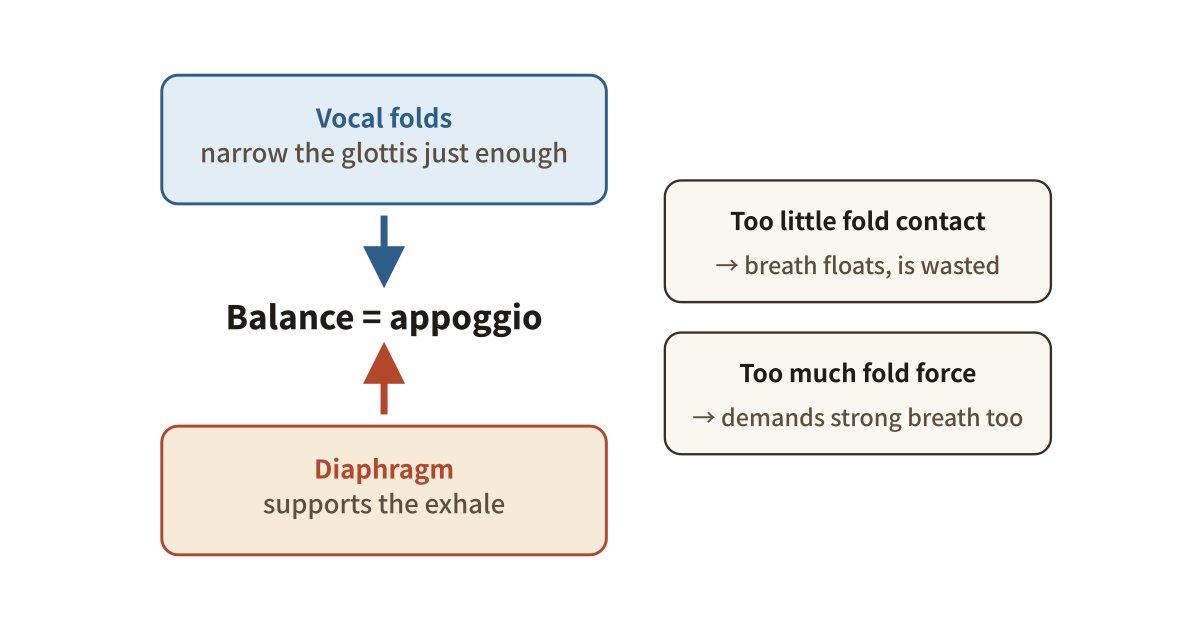
In 2019, Kim Hyuk Gun (김혁건), the vocalist of THE CROSS (더크로스), named appoggio in his doctoral dissertation as the correct way of breathing for the passaggio. And he defined appoggio in a single line: a state of balance of force between the vocal folds and the diaphragm.
This is the eighteenth part of the series. Following the passaggio in Part 17, it sets out the breath that crosses that zone into high notes — appoggio. It is also the part that shows what the "balance of force between the vocal folds and the diaphragm" of Part 6 looks like on high notes.
01.The Conditions for High Notes
In its section on the passaggio, the dissertation sets out the conditions for singing high notes like this.
| The dissertation's explanation | |
|---|---|
| Connection | Fine singing requires a steady connection between low and high notes |
| Breath | Singing high notes requires mastering breathing technique; then you learn to control the low notes and the connection between low and high is smooth |
| Gathering the sound | When passing through the mixed register, you must know how to gather the sound to sing high notes — meaning the sound must be "wrapped" |
| What to avoid | The sound must not turn thin and exposed, brash, dark, or change color suddenly |
| Danger | Narrowing the glottis with excessive force is very dangerous for the vocal folds |
The dissertation notes that adult men typically struggle to carry high notes around "2-octave F" (F4) (Part 17, section 01). The way past that place is the table above, and the breath that holds that table up is appoggio.
02.Appoggio: The Support of the Breath
The dissertation explains appoggio in several layers.
| Point of view | The dissertation's explanation |
|---|---|
| Definition | Achieving the support of the breath; a state of balance of force between the vocal folds and the diaphragm |
| Origin | A remarkable expression for breath control used in traditional Italian singing of the past |
| Ability | The ability to control the breath coming from the lungs. In singing, controlling the breath to produce a steady, rich sound |
| Dictionary meaning | "To sustain," "to support" |
| Two meanings | The functional side of breathing, tied to controlling the inhale and exhale, and the side tied to controlling the sound |
The appoggio training of bel canto seen in Part 14 (the fricative "s~") and the third step of the resonance method in Part 11 — "the balance between the force that sends out and the force that holds back" — all come together in this definition.
03.Breath Alone Cannot Cross It
The dissertation does not see appoggio as a matter of breath alone. In traditional Italian singing of the past, the action of the vocal folds, resonance and breath were not considered separately; because appoggio cannot be gained by controlling the breath alone, today elements beyond the breath are considered too.
| When the balance breaks | What happens |
|---|---|
| Only the breath is controlled and vocal-fold contact is lacking | The breath feels like it floats and is wasted → running short of breath, appoggio becomes impossible |
| Too much force goes into the vocal folds, or they touch too hard | Just as much stronger breath is demanded |
So the dissertation's conclusion is this: appoggio is not a concept limited to controlling and sustaining the breath, but a state that can be reached only when the various elements of the vocal organs are controlled and sustained together.
04.Harmony Found as Two Forces Wrestle
When a singer uses appoggio to produce the right sound, the passaggio proceeds without strain, the dissertation writes. At that point the two forces work like this.
- Vocal folds — narrow the glottis just enough to strengthen the exhale.
- Diaphragm — supports the exhale to send it out strongly.
The dissertation writes that "these two forces wrestling and finding harmony is exactly how the passaggio proceeds." It then compares this to a barbell: at first even a 1kg barbell is hard to lift, but with a great deal of training you can lift 100kg; in the same way, high notes need stronger breath, and that strength is built by training. It adds that baritones who have mastered this sometimes switch to tenor and become "tenoritones" (baritones with a tenor's range).
The dissertation's experiment reached the same place. After passive abdominal breathing produced by pressing on the belly, and singing and breathing training, the range widened, and the dissertation concluded that it had confirmed abdominal breathing as an important factor in overcoming the passaggio (Part 1, section 06).
05.More Resonant, Not Higher
Elsewhere the dissertation gives Pavarotti as an example. Listening to Pavarotti, called "the king of the high C," he sings a 2-octave note, but to the audience it feels as intense as a 3-octave note. So the dissertation concludes: producing a more resonant, strong sound within your own range matters more than attempting higher notes.
High notes are not only numbers but resonance — that is the standard the dissertation sets for high-note practice.
06.Today's Practice
Turned into points to check while you practice, what the dissertation and the lesson highlight looks like this.
- Gather the sound to cross — When passing through the mixed register, gather ("wrap") the sound and listen for sudden changes in tone. Do not narrow the glottis with excessive force (section 01; dissertation p.117).
- Check whether the breath floats — If the breath feels like it floats on high notes, check whether you are controlling only the breath while vocal-fold contact is lacking (section 03; dissertation p.123). Vocal-fold contact continues in the staccato practice of Part 7.
- Gather the sound with a narrow vowel — Lesson Season 2 Ep. 15 (High Notes) covers lowering the diaphragm, gathering the sound with a narrow vowel, and sending the exhale through the nose (video description).
The lesson to watch with this part is Season 2, Episode 15, "High Notes." Its description lists lowering the diaphragm, gathering the sound with a narrow vowel, sending the exhale through the nose, and the three elements of breath, vocal folds and resonance.
07.Where to Go Next
The principle of the passaggio is in Part 17 · Passaggio, and the balance between the vocal folds and the diaphragm in Part 6. From the next part the series moves to vocal education in practice — Part 19 · Posture and Correct Breathing. Kim Hyuk Gun's three-octave high notes and repertoire are in Kim Hyuk Gun's Voice: Three-Octave High Notes and Hard Rock Roots, and a song that carries those high notes in THE CROSS on Sugar Man 3: "Don't Cry" and "For You". Lesson videos are in Korean.
Like starting at 1kg and working up to 100kg — the strength that holds up a high note grows a little every day.