In 2019, Kim Hyuk Gun (김혁건), the vocalist of THE CROSS (더크로스), defined support in his doctoral dissertation like this: "The exhale is the sound, and support is the technique of the exhale." And he wrote that training in support forms the main part of vocal education.
This is the twentieth part of the series. Following posture and correct breathing in Part 19, it sets out the next step — support, which manages that breath through the whole song.
01.Support: A Conscious, Slow Exhale
The dissertation writes that support does not come from the start. It does not happen ordinarily, but once you can keep good posture and breathing and your singing becomes skilled, you can at last consciously influence the exhale — and this process is called "support."
| Name | The dissertation's explanation |
|---|---|
| Support | An important element of singing and an essential part of singing education |
| Conscious, slow exhale | Another name for support |
| Restrained exhalation | The process of controlling the exhale with diaphragm tension and by narrowing the glottis |
Season 1, Episode 5, "Singing Technique," seen in Part 1, also describes support as "restrained exhaling" in its description.
02.The Exhale Carries the Sound
The dissertation shows that the exhale carries sound through a simple observation. If you close your mouth and block both nostrils and try to make a sound, no sound comes out; open only one nostril and sound comes only from there; block the nose and open the mouth and it comes only from the mouth (Part 10, section 04). In the end, it is the exhale that sends the sound out.
| The dissertation's explanation | |
|---|---|
| Sound | Is the vibration of air |
| Tone | Not only in singing but in speech, you can have many tones depending on how you adjust the exhale |
| Resonance | You can change the tone by making the air resonate in the throat (pharynx) or the nose (nasal cavity) |
| Contact | Air on its way out strikes the tongue, teeth and lips, creating many changes of tone |
| The end | Without breath you cannot sing, and once the breath is used up it is hard to make any more sound |
So the dissertation concludes: adjusting the exhale and controlling the vibration of the air — that is the breathing technique of singing.
03.Holding the Breath in Two Places
After quoting Caruso — "My voice comes from the lower abdomen" — the dissertation explains the principle of support as two kinds of control.
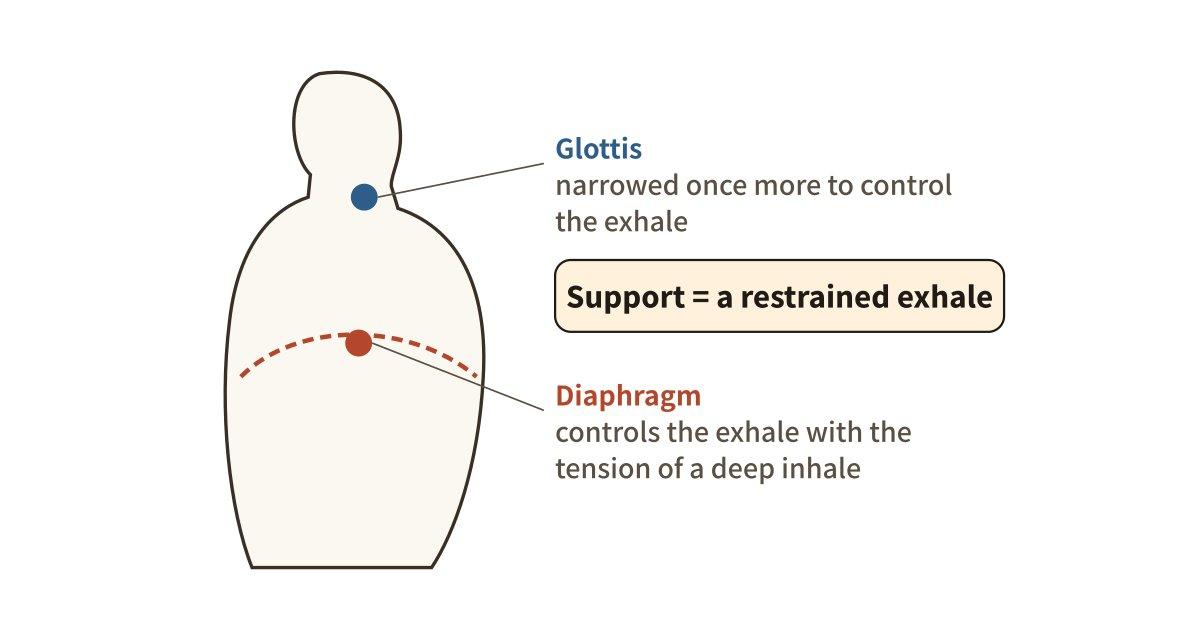
- Diaphragm — For a steady exhale, take a deep inhale, and use the tension in the diaphragm it creates to control the exhale.
- Glottis — At the vocal folds, narrow the glottis once more so it vibrates, controlling the exhale.
This process is called support, or restrained exhalation, the dissertation writes. By narrowing the glottis at the vocal folds you can hold the breath coming from the lungs so it does not simply go out, and it is important to feel the difference in quality and resonance between a closed and an open glottis, it adds.
The two places — the diaphragm below and the glottis above — are the same two forces as the "balance of force between the vocal folds and the diaphragm" in Part 6 and appoggio in Part 18. Support is keeping that balance for the length of a note.
04.A Sound That Wastes No Breath
"Support training is needed to keep the sound steady without wasting breath and to move into the high range." The dissertation ties the purpose of support into three.
| The purposes of support |
|---|
| Wasting no breath |
| Keeping the sound steady |
| Moving into the high range |
It then quotes García: "A fine singer can hold a candle in front of the mouth while singing without the flame flickering." The breath goes out as sound, and breath that has not become sound does not leak out.
Ways to practice support are found throughout the dissertation too. The singing practice table (Table 17) says that nasal resonance — humming through the passaggio with the mouth closed — is good for practicing support because the exhale cannot leave through the mouth, and the section on nasal resonance sees the nasal sound as an extension of a conscious, slow exhale through humming, that is, support (Part 10, section 05).
05.Today's Practice
Turned into points to check while you practice, what the dissertation and the lesson highlight looks like this.
- Hum through the passaggio — With the mouth closed, hum through the passaggio. The dissertation writes that this is good for practicing support because the exhale cannot leave through the mouth (section 04; dissertation p.166).
- Closed and open glottis — While singing the same note, feel the difference in quality and resonance between a closed and an open glottis (section 03; dissertation p.158).
- Hold one note long — Lesson Ep. 7 (Support and Tone Control) covers support by holding one note long, and keeping the breath by lowering the diaphragm and bringing the vocal folds together (video description).
The lesson to watch with this part is Season 1, Episode 7, "Support and Tone Control." Its description lists holding one note long (support), tone control using resonance, the maxillary sinus, and keeping the breath by lowering the diaphragm and bringing the vocal folds together.
06.Where to Go Next
Posture and correct breathing are in Part 19 · Posture and Correct Breathing, and pitch and range practice kept by support continue in Part 21 · Pitch, Range and Interval Practice. The duet Kim Hyuk Gun sang with Park Ki-young can be heard in Kim Hyuk Gun and Park Ki-young's "The Prayer": Winning the 2017 New Year Special of Immortal Songs. Lesson videos are in Korean.
So the candle does not flicker — all the breath goes out as sound.