In 2019, Kim Hyuk Gun (김혁건), the vocalist of THE CROSS (더크로스), included an item called "resonance methods" in the "respiratory rehabilitation and vocal education" section of his doctoral dissertation. Following the earlier chapter that set out why resonance matters, it describes the order in which that resonance is learned in the body.
This is the eleventh part of the series. It sets out how to actually make the resonators seen in Part 9 and Part 10 resonate.
01.A Whistle Starts at the Lips, the Voice at the Vocal Folds
The dissertation opens resonance methods with a comparison. A whistle's vibration starts at the lips; the voice's vibration starts at the vocal folds and takes on the resonance of the resonating spaces above them. Where a sound starts and where it grows are different places.
So the dissertation divides the order of resonance training into two. First you learn where resonance sits; next you learn in your body how to make that place resonate to produce a good sound.
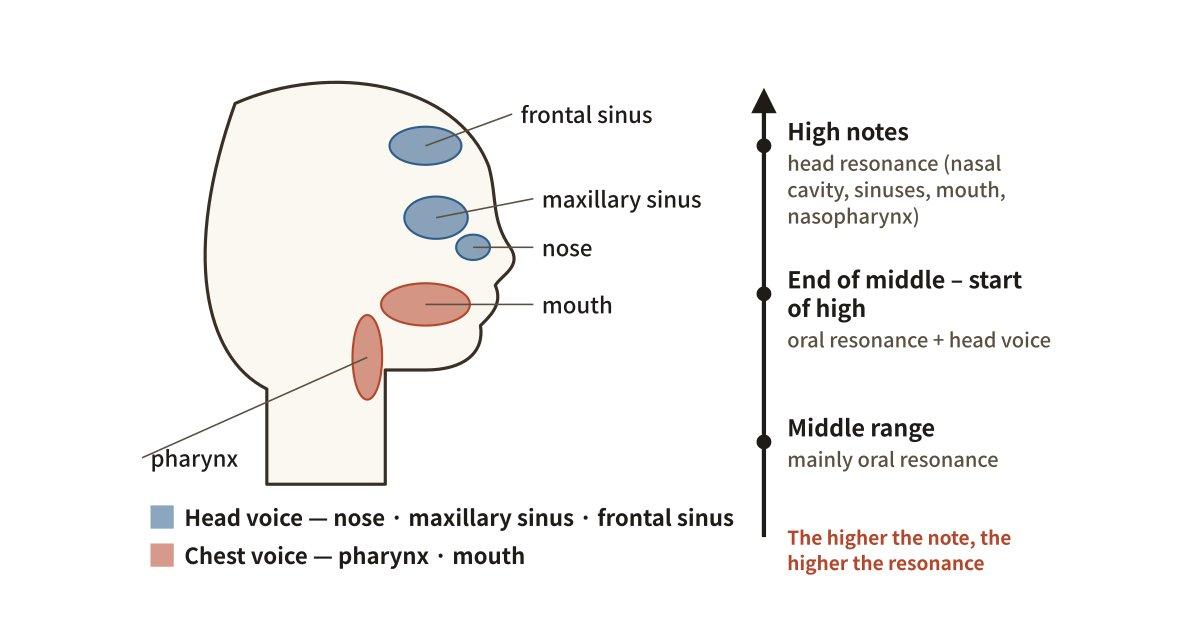
02.Chest Voice and Head Voice: They Ring in Different Places
| Popular-music term | Where it rings |
|---|---|
| Chest voice | The pharynx and the mouth |
| Head voice | Resonating spaces in the head such as the nose, maxillary sinus and frontal sinus |
Because of its name, it is easy to think of chest voice as a sound that rings in the chest, but in the dissertation's summary the place where chest voice rings is the pharynx and the mouth. Chest voice gets its own part in Part 12, and head voice in Part 13.
03.Each Range Rings in a Different Place
The dissertation explains that the resonance mainly used differs with range.
| Range | Resonance mainly used |
|---|---|
| High notes | The head resonating cavities — head resonance (all resonance including the nasal cavity, sinuses, mouth and nasopharynx) |
| End of the middle range ~ start of the high range | Oral resonance and head voice blend appropriately |
| Middle range | Mainly oral resonance |
As seen in Part 6, the dissertation explains the place of resonance rising higher as the note gets higher as the principle of resonance. Head voice is the sound made when the vocal folds narrow and strong abdominal pressure sends the exhale high to resonate a higher place among the spaces of the head. As the note rises, the resonance moves from the mouth toward the head.
04.Five Steps to Making Resonance
The dissertation sets out, in five steps, the order of how the body should move to learn resonance.
- Lift the soft palate up high.
- Lower the tongue root to prepare for oral resonance.
- Achieve the balance between the force that sends out and the force that holds back — that is, appoggio.
- Sing with the feeling of turning the sound back (girare) — in order to use several resonating spaces.
- Keep a balanced abdominal pressure throughout.
| Step | Where in the body | More in this series |
|---|---|---|
| 1·2 | Inside the mouth — the soft palate and tongue root | Part 9, section 05; Part 12 |
| 3 | The breath — the force that sends out and the force that holds | Part 18 · High Notes and Appoggio |
| 4 | The direction of the sound — turning it back | Part 16 · Vibrato Practice and Dollyeonaegi |
| 5 | The belly — balanced abdominal pressure | Part 6 |
Steps 3 and 5 are the same story as the "balance of force" in Part 6. Resonance is made not only by the shape of the mouth and nose but on top of the balance of the breath.
05.You Need to Use Several Sound Boxes
The dissertation writes that when resonance happens, the sound becomes clean and resonant, and that using head voice properly requires knowing the correct resonance method. And it concludes: because the color of sound and resonance differs with the position of the resonating cavity, you need to be able to use several resonating cavities to express many sounds and emotions.
No single resonance can sing every song. Moving between where chest voice rings, where head voice rings and where the two blend, the feeling of a song changes.
06.Today's Practice
Turned into points to check while you practice, what the dissertation and the lesson highlight looks like this.
- One note in five steps — Check the order in section 04 one step at a time while holding one comfortable note (dissertation p.164).
- Does the abdominal pressure hold to the end? — While singing one note, check that step 5, "balanced abdominal pressure," continues from start to finish (section 04; dissertation p.164).
- Lift the soft palate, lower the tongue root, practice nasal resonance — Lesson Season 2 Ep. 12 (Resonance) covers lifting the soft palate and lowering the tongue root, and nasal resonance practice (video description).
The lesson to watch with this part is Season 2, Episode 12, "Resonance." Its description lists that head voice, chest voice and nasal resonance all make the head ring, the resonance of the maxillary sinus, lifting the soft palate and lowering the tongue root, and nasal resonance practice. The lesson's description says that chest voice, too, makes the head ring, while the dissertation explains chest voice in popular music as sound that resonates the pharynx and the mouth (section 02). This series follows the dissertation's explanation and treats the lesson as material to watch alongside it.
07.Where to Go Next
The ringing of the nose and nasal resonance are in Part 10 · The Nasal Cavity, Sinuses and Using Nasal Resonance, and the tongue root and soft palate of steps 1 and 2 continue in Part 12 · Chest Voice. The song, book and talk that share one title are gathered in "You Can Do It": The Song, the Book, and the Talk. Lesson videos are in Korean.
Once you know where the sound boxes are, it is time to learn their resonance in your body.