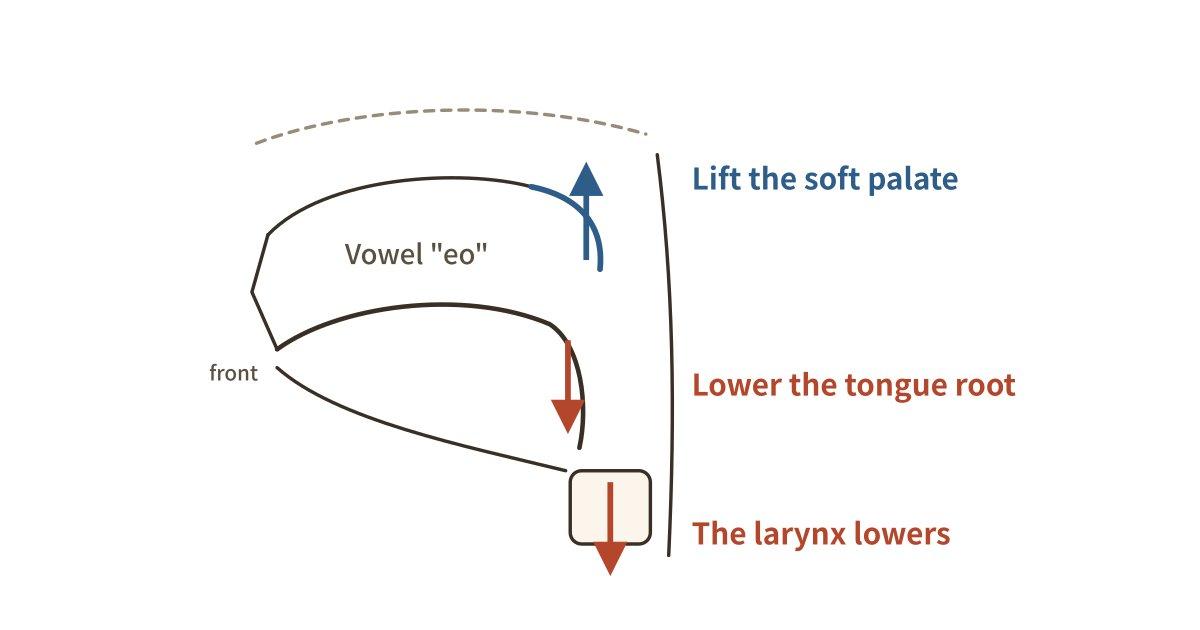
In 2019, Kim Hyuk Gun (김혁건), the vocalist of THE CROSS (더크로스), named "lowering the tongue root and lifting the soft palate" in his doctoral dissertation as one of the exercises for scientific vocal technique. It is an exercise that moves two places inside the mouth — the root of the tongue and the soft part at the back of the roof of the mouth — to create resonating space.
This is the twelfth part of the series. It sets out in detail, from the point of view of chest voice, steps 1 and 2 of the resonance method in Part 11 (lifting the soft palate, lowering the tongue root).
01.Chest Voice Is Not a Sound That Rings in the Chest
Because of the name, it is easy to think of chest voice (흉성, literally "chest sound") as a sound that rings in the chest. Gathering several passages of the dissertation, the place of chest voice lies elsewhere.
| Passage in the dissertation | On chest voice |
|---|---|
| Resonance methods (p.163) | In popular music, resonating the pharynx and mouth is called chest voice |
| Using nasal resonance (p.162) | If the nose is blocked and the exhale cannot get out through it, the sound comes only from the mouth, so it is closer to chest voice (oral resonance) than to nasal resonance (head resonance) |
| Range (p.174) | Low notes = chest voice = full voice |
The dissertation also explains the bel canto register name "chest register" seen in Part 8 as "a range that seems to resonate in the chest." It is a sound that seems to ring in the chest, and the dissertation explains chest voice in popular music as sound that resonates the pharynx and mouth. The lesson paired with this part also lists "chest voice is not the chest ringing" as the first point in its description.
02.Lowering the Tongue Root: Space for Deep Low Notes
"By lowering the tongue root, a resonating cavity is created in the mouth and the larynx is lowered, so a deeper, more resonant low range can be expressed." The dissertation's explanation holds two things in one sentence.
| Lowering the tongue root | Result |
|---|---|
| Creates a resonating cavity in the mouth | The space for resonance widens |
| Lowers the larynx | A deeper, more resonant low range |
The height of the larynx also came up in Part 5. The dissertation states that the position of the larynx changes the texture and size of the sound and the length of the vocal tract, and introduces a study in which phonating with the larynx lowered increased loudness and the vocal-fold contact rate. Lowering the tongue root is also a way of lowering that larynx.
03.Lifting the Soft Palate: Widening the Mouth with "Eo"
The dissertation writes about lifting the soft palate in more detail.
- Lifting the soft palate and widening the mouth makes it possible to sing the overtones of a deeper, more resonant low range together with high notes.
- Lifting the soft palate high while widening the mouth and turning the sound so that it reaches the hard palate carries the resonance through the bone up to the frontal sinus.
- Practice on "eo" (어), a vowel suited to lifting the soft palate.
- When the sound is turned, the mouth widens, so the vowel "ah" sounds close to "eo."
- Use the space of the mouth as widely as possible, with the feeling of the cheeks expanding left and right too.
As seen in Part 9, the soft palate is the soft part of the roof of the mouth that separates the nasal cavity from the mouth, and in ordinary phonation it is raised. The dissertation also writes that lowering the larynx and lifting the soft palate as in a natural yawn creates a resonating cavity in the mouth. The depth of low notes (tongue root) and the overtones within high notes (soft palate) — the two movements are used together.
04.Tongue and Larynx: Finding the Natural Position
In its "tongue and larynx" item, the dissertation separates two things about sound: pitch is determined by the vocal folds and the diaphragm, and pronunciation by the tongue and the structure of the mouth. It then writes about what happens when the tongue and larynx are in the wrong place.
| Range | The tongue root and larynx | Result |
|---|---|---|
| Low range | Rise | The richness of the low notes is lost |
| High range | The tongue root drops too far | The edge of the high notes is lost |
So the dissertation's conclusion is that "it is important to find a natural position for the tongue and larynx and sing." It means not lowering the tongue root at all costs, but finding the position that suits the range.
05.The Lesson's Chest-Voice Steps and the Dissertation
Season 1, Episode 6, "Chest-Voice Technique," seen in Part 4, lists four steps of chest-voice singing in its description. Pairing the steps that have a matching passage in the dissertation gives this.
| Lesson step (video description) | Passage in the dissertation | In this series |
|---|---|---|
| Breathe in through the nose | The short inhale; the inhale that comes in through the nasal cavity | Parts 4 and 9 |
| Keep the shoulders and chest still | In chest breathing, when the shoulders and collarbones rise, the larynx rises with them | Part 3 |
| Tongue root and soft palate | Lowering the tongue root, lifting the soft palate | This article |
| Gathering the mouth | — (no passage of the same name in the dissertation) | — |
06.Today's Practice
Turned into points to check while you practice, what the dissertation and the lesson highlight looks like this.
- Lift the soft palate on "eo" — Sing on "eo" (어), a vowel suited to lifting the soft palate. When you turn the sound, "ah" sounds close to "eo" (section 03; dissertation p.175).
- Widen to the cheeks — Use the space of the mouth as widely as possible, with the feeling of the cheeks expanding left and right (section 03; dissertation p.175).
- Tongue root and larynx on low notes — On low notes, check that the tongue root and larynx do not rise. If they rise, the richness of the low notes is lost (section 04; dissertation p.177).
- Lift the soft palate with a yawn — Lesson Season 2 Ep. 1 (Chest Voice) covers widening the mouth and lifting the soft palate with a yawn (video description).
The lesson to watch with this part is Season 2, Episode 1, "Chest Voice." Its description lists that chest voice is not the chest ringing, widening the mouth, and lifting the soft palate with a yawn.
07.Where to Go Next
The five steps of making resonance are in Part 11 · Resonance Methods, and head voice, chest voice's partner, continues in Part 13 · Head Voice — a Bright "E" and the Maschera. A rock vocalist moving between deep low notes and high notes can be heard in THE CROSS Band's Rock Covers. Lesson videos are in Korean.
Lower the tongue root and lift the soft palate — a deep sound comes from a widened mouth.