In 2019, Kim Hyuk Gun (김혁건), the vocalist of THE CROSS (더크로스), wrote this aim of vocal training in his doctoral dissertation: to understand the nature of the registers so that the low, middle and high parts of the voice form one even line.
This is the eighth part of the series. Following full voice in Part 7, it sets out falsetto and registers — how sound is divided into zones, and how those zones are joined.
01.The Order of Vocal Training, and Registers
At the start of its "vocal technique" chapter, the dissertation sets out the order vocal training generally goes through.
| Step | Training | Purpose |
|---|---|---|
| 1 | Breathing training | To produce the voice |
| 2 | Range training | To build a beautiful voice |
| 3 | Understanding the nature of the registers | To make the low, middle and high parts form one even line |
| 4 | Various techniques such as falsetto, vowels, consonants and messa di voce | To express freely the musical skills and expression a song asks for |
Falsetto first appears in the fourth row of this table, as one of the various techniques. The series follows the same order: after breathing (Parts 2–4) and the vocal folds (Parts 5–7), this part covers registers.
02.What Is a Register?
The dissertation explains a register as "the basic unit of vocal technique, in which the range of sound a person can make is divided into one, two, four or five, and each register is then refined and studied." Italian bel canto divides the registers into three.
| Bel canto register | The dissertation's explanation |
|---|---|
| Middle register | The range you can sing naturally and comfortably, as when talking |
| Chest register | A range that seems to resonate in the chest |
| Head (high) register | A range rich in skull resonance that reaches the center of the mask |
The dissertation also presents the opposing view: some vocal theorists and singers oppose dividing the registers in many ways and refining each, because dividing and teaching them artificially can make things more complicated and unsettled. Even so, the dissertation notes that register theory is a generally accepted theory.
03.Men's Three Registers: Chest, Head and Falsetto
The dissertation divides men's registers into three: chest voice, head voice and falsetto.
| Register | The dissertation's explanation |
|---|---|
| Chest voice | Men use the chest register more than women. Low voices such as basses sing mostly in chest voice alone. Sound from the chest register is rich in overtones |
| Head voice | A blended sound that mixes light and heavy sound well |
| Falsetto | The third of men's registers |
Drawing on García, the dissertation gives how high the color of the chest register can reach: D4 for basses, E♭4 for baritones, and F4 or F♯4 for tenors. It also writes that the part where men's head and chest registers mix is men's passaggio. The passaggio is covered in detail in Part 17.
04.Women's Three Registers: Chest, Middle and Head
Women's main registers are chest, middle and head.
| Register | The dissertation's explanation |
|---|---|
| Chest | Because the vocal folds are wide, they tremble when they vibrate, much like a flag flapping. Opinions differ on how high chest voice can be taken — one view (Bernard) holds that up to D4 is suitable, another (Mathilde Marchesi) that F♯4 or E4 is the highest note |
| Middle | Roughly between C4 and F5. The lowest three notes can be sung in either the chest or the middle register |
| Head | From C♯5 to F5 is the passaggio between the middle and head registers, so a well-blended sound of the two registers is used |
The dissertation writes that the lower part of women's middle register needs steady practice, because if the vowels are not handled clearly, a breathy sound easily comes in place of a clean one. It gives the remedy too: brighten the vowels to make the resonance bright, so that the sound gathers into a focus. And, citing Dr. Brodnitz, it notes that for the middle register to sound ideal, the registers must be blended — singing with the sense that head and chest voice are present together.
05.Joining Falsetto and Full Voice
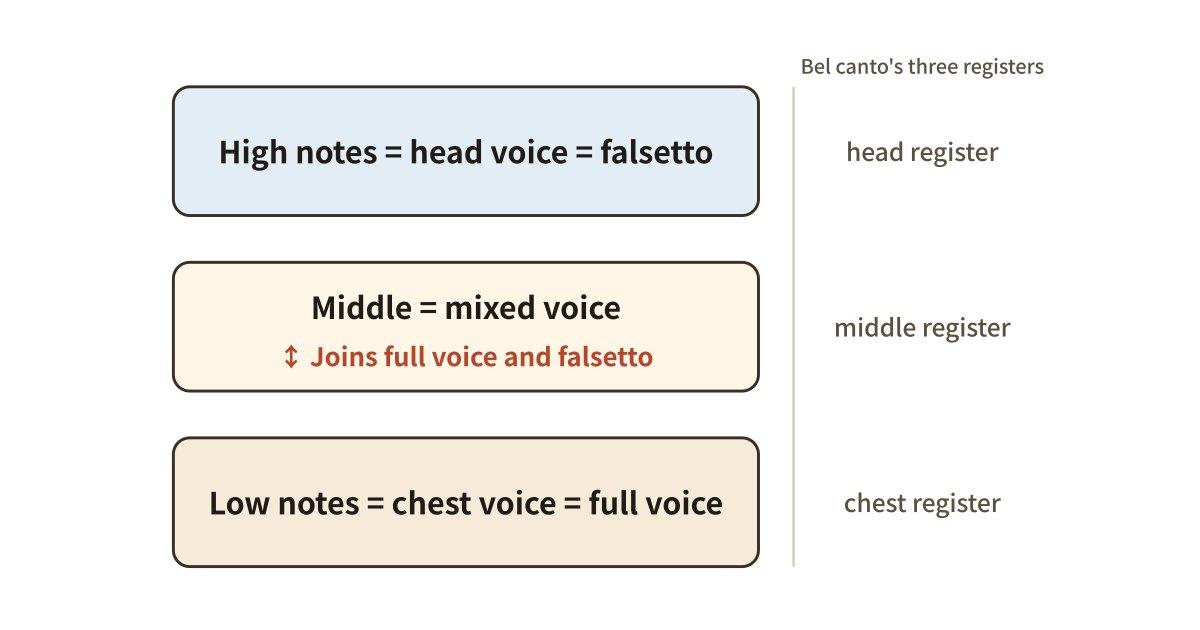
The dissertation matches ranges with the names of the sounds like this.
| Range | Sound |
|---|---|
| High notes | Head voice = falsetto |
| Middle | Mixed |
| Low notes | Chest voice = full voice |
High notes are easy in falsetto but low notes are hard in falsetto; low notes are easy in full voice but high notes are hard in full voice. That is why the mixed register is practiced. The dissertation explains that to take excess force out of the middle range and avoid straining the vocal folds, full voice and falsetto have to be connected.
Elsewhere the dissertation uses the phrase "the 가성대 (false vocal folds), the high range," and writes that you should understand the structure of the false vocal folds and the vocal folds and learn how to narrow the glottis to resonate the higher head cavity. And after setting out the differences by voice type and sex, it names learning to mix head and chest voice on low notes as the main goal of singing common to all.
Divide them to learn them, then join them again — that is the order of register practice in the dissertation.
06.Today's Practice
Turned into points to check while you practice, what the dissertation and the lesson highlight looks like this.
- Divide your range into three zones — Take the range you noted in Part 1, divide it into low, middle and high, and sing in each zone separately. The dissertation explains a register as the basic unit of vocal technique in which the range is divided and each part refined (section 02; dissertation p.114).
- Where the breathiness comes in — If breath creeps into the sound in the lower middle range, brighten the vowel and gather the sound into a focus (section 04; dissertation p.122).
- Head and chest together — At the borders between zones, sing with the sense that head and chest voice are present together (sections 04 and 05; dissertation pp.122, 116).
- Compare falsetto and full voice — Lesson Season 2 Ep. 10 (Falsetto) covers the difference between falsetto and full voice (video description). Sing the same note in both sounds and listen to the difference.
The lesson to watch with this part is Season 2, Episode 10, "Falsetto." Its description lists falsetto as the basis of shout singing and the difference between falsetto and full voice. Shout singing comes up again in the lesson for Part 23.
07.Where to Go Next
Full voice and bringing the folds together are in Part 7 · Chest (Full) Voice, and the passaggio, the zone where registers change, is in Part 17 · Passaggio. From the next part on, the series moves to resonance, which amplifies the sound made at the vocal folds — Part 9 · The Resonators. The songs THE CROSS newly recorded for its 20th anniversary are in THE CROSS 20th Anniversary Project: Poem of the Wind. Lesson videos are in Korean.
When the low, middle and high parts become one line, you no longer hear the seams in the song.