In 2019, in the experimental lessons of his doctoral dissertation, Kim Hyuk Gun (김혁건), the vocalist of THE CROSS (더크로스), made the sixth session "learning vocal technique" and covered lessons 1-7 "Support vocal technique, tone control" and 2-8 "How to do vibrato, how to practice vibration well" together. It was a session that treated vibrato not as a principle but as something to practice.
This is the sixteenth part of the series. Following the principle in Part 15, it sets out how to practice vibrato, and girare (돌려내기, dollyeonaegi) — turning the sound round.
01.Where Vibrato Practice Starts
The dissertation's conclusion in Part 15 was that vibrato comes on its own as the result of steady vocal practice. Still, for when it does not come, the dissertation gives two kinds of practice.
| When vibrato does not come | Practice |
|---|---|
| First check whether the breathing muscles are too tense | ① Adjust loud and soft in time with the beat |
| ② Move the larynx and diaphragm |
The description of the lesson paired with this part lists dividing the beat and holding the same note as its points. It is practice in dividing the tremble in time with the beat while keeping the pitch.
02.When Force Stiffens, Vibrato Stiffens
The dissertation mentions vibrato again in its "muscle relaxation" item: in phonation, tensing, concentrating and applying force matter, but settling and releasing tension also matter a great deal.
| The dissertation's explanation | |
|---|---|
| Muscles around the neck | You must know how to relax them very comfortably |
| Control of force | Not releasing all force and tension, but keeping an appropriate state |
| Vibrato without that control | Can sound very stiff, and the beat is hard to divide smoothly |
| Too much force | Applying excess force while lowering the tongue root and larynx puts force into the throat and the sound can turn stiff. Excessive force always makes the sound unnatural |
Not applying force is a problem, but applying too much force is also a problem, the dissertation concludes. And it writes that you must sing turning the sound round, with the muscles of the whole body relaxed. That sentence is why vibrato practice and turning the sound are tied together in one part. Muscle relaxation continues in Part 23.
03.Girare: Turning the Sound
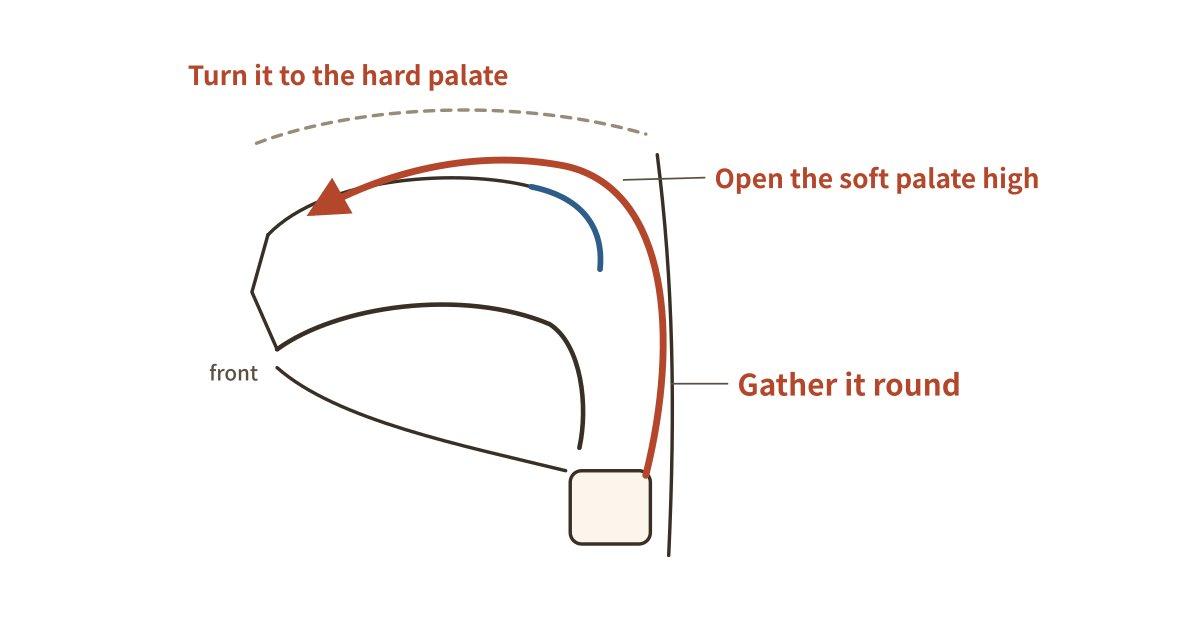
Girare means "to turn," and refers to turning the sound from back to front. The dissertation writes the method like this.
- Open the roof of the mouth at the soft palate well, so it rises.
- Turn the sound and send it to the hard palate.
- Gather the sound round.
And it adds an image for the feeling: sing the sound richly, like a marble rolling across marble.
There is a passage that connects to lifting the soft palate in Part 12 too. Lifting the soft palate high to widen the mouth and turning the sound so it reaches the hard palate carries the resonance through the bone up to the frontal sinus, and turning the sound widens the mouth so the vowel "ah" sounds close to "eo," the dissertation writes.
04.Girare Within the Resonance Method
Girare also appears in the five steps of resonance in Part 11. The fourth step is "sing with the feeling of turning the sound back (Girare)," and the reason is to use several resonating spaces.
| Passage in the dissertation | Girare |
|---|---|
| Resonance method d (p.164) | The feeling of turning the sound back — to use several resonating spaces |
| Turning the sound (p.176) | Turn the sound from back to front, to the hard palate, gathered round |
| Lifting the soft palate (p.174) | Turn the sound to reach the hard palate → resonance up to the frontal sinus |
| Experimental lessons (Tables 4 and 5) | Lesson 1-5, "Passaggio, support, pitch, resonance, girare," was covered in session 3 |
Girare is not a separate technique standing apart; it sits where resonance, the soft palate and relaxation meet.
05.Today's Practice
Turned into points to check while you practice, what the dissertation and the lesson highlight looks like this.
- Loud and soft in time with the beat — Adjust the loudness of one note in time with the beat (section 01; dissertation p.113).
- Divide the beat, keep the same note — Lesson Season 2 Ep. 8 covers dividing the beat and holding the same note (video description). If the beat divides stiffly, check that force has not gone into the muscles around your neck (section 02; dissertation p.172).
- Open the soft palate and turn the sound to the hard palate — Open the roof of the mouth at the soft palate so it rises, turn the sound and send it to the hard palate, and gather it round (section 03; dissertation p.176).
The lesson to watch with this part is Season 2, Episode 8, "Vibration." Its description lists that "vibrato" is a more accurate term than "vibration," dividing the beat, and holding the same note.
06.Where to Go Next
The principle of vibrato is in Part 15 · How Vibrato Works, and the five steps of resonance in Part 11 · Resonance Methods. The next part covers the zone where registers change, Part 17 · Passaggio. THE CROSS's recent stage can be seen in THE CROSS's Open Concert Finale: "Poem of the Wind" and "Don't Cry". Lesson videos are in Korean.
Like a marble rolling across marble — a sound turned round trembles smoothly.