KIM HYUK GUN
MusicArtistBandLive & LectureMediaJournal한국어Booking
한국어
← Journal
Research

Kim Hyuk Gun's Research on Vocal Technique 15/24 · Vibrato: A Tremble That Comes from Practice

Vibrato is not a technique you build separately — once steady vocal practice lets you control the breathing muscles, it comes on its own, the dissertation says.

2026-10-30 · 4 min read

▶ This part's vocal lesson

Cross Kim Hyuk Gun Vocal Lessons, How to Sing Well Ep. 4: Vibration and Vibrato · 뮤토리 (Mutory)

Part 15 of 24Kim Hyuk Gun's Research on Vocal Technique (24 parts)

This series reads Kim Hyuk Gun's doctoral dissertation, 「횡격막 마비군과 비마비군을 통한 복식호흡과 발성법 연구」 ("A Study of Abdominal Breathing and Vocal Technique in Groups With and Without Diaphragmatic Paralysis," Kyung Hee University, 2019), in 24 parts for popular-music vocal students, pairing each part with one of the vocal lessons he taught. The study was approved by the Kyung Hee University Institutional Review Board (IRB; project no. KHSIRB-17-047) and was carried out as a human-subjects experiment with the informed consent of its participants.

At a Glance

  • Kim Hyuk Gun's doctoral dissertation (2019) distinguishes vibration — the vibration itself, the ringing of the vocal folds — from vibrato, the technique of making the voice or an instrument waver regularly.
  • In classical singing, tremolo (repeating one note in 8, 16, 24 or 32 beats and so on) is distinguished from vibrato.
  • Vibrato is an important singing technique for adjusting pitch and beat to the mood and rhythm of a song and the singer's emotion.
  • The dissertation concludes that once steady vocal practice lets you control the breathing muscles, vibrato comes on its own.
  • If vibrato does not come, check whether the breathing muscles are too tense, and practice adjusting loud and soft in time with the beat or moving the larynx and diaphragm.

Quick AnswerKim Hyuk Gun's (김혁건) 2019 doctoral dissertation distinguishes vibration, the ringing of the vocal folds itself, from vibrato, the technique of making the voice waver regularly, and concludes that once steady vocal practice lets you control the breathing muscles, vibrato comes on its own.

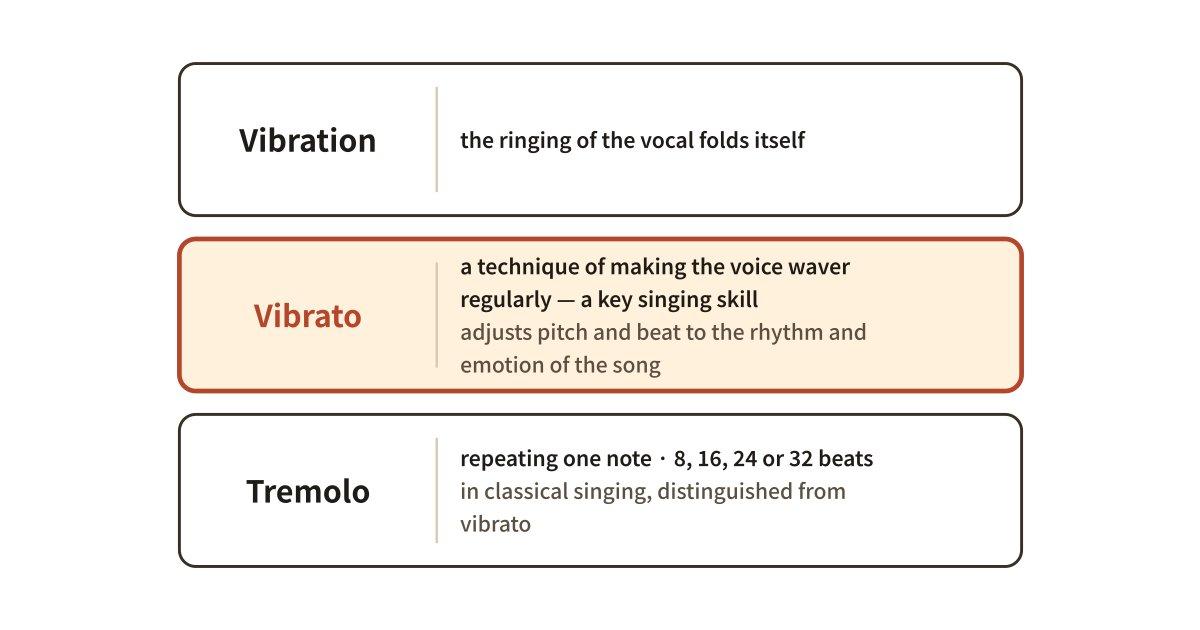
Diagram distinguishing vibration, vibrato and tremolo side by side

Contents

  1. 01Vibration and Vibrato Are Different
  2. 02Tremolo and Vibrato
  3. 03What Vibrato Does in Singing
  4. 04The Body Always Trembles
  5. 05Vibrato Comes as the Result of Practice
  6. 06Today's Practice
  7. 07Where to Go Next

In 2019, Kim Hyuk Gun (김혁건), the vocalist of THE CROSS (더크로스), gave vibrato its own section in the "vocal technique" chapter of his doctoral dissertation, after bel canto and modern scientific vocal technique. And he wrote this conclusion to that section: with steady vocal practice you become able to control the breathing muscles, and vibrato comes on its own.

This is the fifteenth part of the series. It sets out how vibrato works — what trembles, and why it comes with practice. How to actually practice vibrato continues in Part 16.

01.Vibration and Vibrato Are Different

The dissertation first distinguishes the two words.

TermThe dissertation's explanation
VibrationThe vibration itself — the ringing of the vocal folds, that is, sound
VibratoIn musical performance, the technique of making the voice or an instrument waver regularly

Vibration is in every sound. As seen in Part 5, sound is made only when the vocal folds vibrate. Vibrato is the technique of making that sound tremble by a regular rule. Where vibrato is made also differs from instrument to instrument: on string instruments it comes from how fast the finger moves on the string, and on wind instruments from the control of the breath, the dissertation writes.

02.Tremolo and Vibrato

TremoloVibrato
The dissertation's explanationA technique of repeating one note. 8 beats, 16 beats, 24 beats, 32 beats and so onThe technique of making the voice waver regularly
In classical singingDistinguished from vibratoAn important singing technique

A footnote in the dissertation explains tremolo as a way of playing that repeats a note or chord quickly, as if trembling, used mainly in instrumental music. The description of the lesson paired with this part uses the expression "8-, 16- and 24-beat vibrato." The dissertation gives 8, 16, 24 and 32 beats as examples of tremolo, while also writing that vibrato, too, adjusts the beat to the rhythm of the song. This series uses the two terms as the dissertation distinguishes them.

03.What Vibrato Does in Singing

The dissertation names vibrato as an important technique in singing and explains its use like this: adjusting the pitch and beat to the mood and rhythm of the song, and to the emotion of the singer.

In the dissertation's experimental lessons, too, vibrato was covered in session 3, "vocal technique," with lesson 1-4, "Vibration, vibrato" (Part 1, section 05).

04.The Body Always Trembles

The dissertation uses a pencil to explain why vibrato is not hard. The human body is always vibrating and trembling, so just as it is very hard to draw a perfectly straight line with a pencil, making it tremble by a regular rule is easier than making sound with no tremble at all.

Not creating a new tremble, but giving a rule to the tremble already there — that is where vibrato starts, as the dissertation explains it.

05.Vibrato Comes as the Result of Practice

"With steady vocal practice, you become able to control the breathing muscles, and vibrato comes on its own." So the dissertation writes where to look first when vibrato does not come.

When vibrato does not comeThe dissertation's explanation
What to checkSuspect whether the breathing muscles are too tense
Practice ①Adjust loud and soft in time with the beat
Practice ②Move the larynx and diaphragm

The dissertation's background chapter points the same way: the diaphragm enlarges the vibration of the vocal folds, regulates its width and helps create varied, rich tones in singing. Vibrato follows once you can control the muscles that handle the breath — that is the dissertation's conclusion.

06.Today's Practice

Turned into points to check while you practice, what the dissertation and the lesson highlight looks like this.

  1. Check for tension — If vibrato does not come, first check that the breathing muscles are not too tense (section 05; dissertation p.113).
  2. Loud and soft in time with the beat — Try adjusting the loudness of one note in time with the beat (section 05; dissertation p.113).
  3. Listen for vibration versus vibrato — Lesson Ep. 4 explains vibration (vibration) and vibrato (a singing technique) separately (video description).

The lesson to watch with this part is Season 1, Episode 4, "Vibration and Vibrato." Its description lists the distinction between vibration (vibration) and vibrato (a singing technique), and 8-, 16- and 24-beat vibrato. The beat expressions and the dissertation's distinction between the terms are set out in section 02.

07.Where to Go Next

The course from bel canto to scientific vocal technique is in Part 14 · From Bel Canto to Modern Scientific Vocal Technique, and how to practice vibrato and girare, turning the sound, continue in Part 16 · Vibrato Practice and Dollyeonaegi. The songs THE CROSS newly recorded for its 20th anniversary are in THE CROSS 20th Anniversary Project: Poem of the Wind. Lesson videos are in Korean.

The body is already trembling — vibrato comes when the breath gives that tremble a rule.

← Previous partKim Hyuk Gun's Research on Vocal Technique 14/24 · From Bel Canto to Scientific Vocal TechniqueNext part →Kim Hyuk Gun's Research on Vocal Technique 16/24 · Vibrato Practice and Dollyeonaegi (Turning the Sound)

Frequently asked questions

Do vibration and vibrato mean the same thing?

No. Kim Hyuk Gun's doctoral dissertation distinguishes vibration — the vibration itself, the ringing of the vocal folds — from vibrato, the technique of making the voice or an instrument waver regularly.

How are tremolo and vibrato different?

The dissertation explains tremolo as a technique of repeating one note (8, 16, 24 or 32 beats and so on), and writes that in classical singing tremolo and vibrato are distinguished.

How do you learn vibrato?

The dissertation concludes that once steady vocal practice lets you control the breathing muscles, vibrato comes on its own.

What if vibrato won't come?

The dissertation writes to suspect whether the breathing muscles are too tense, and presents practice in adjusting loud and soft in time with the beat or moving the larynx and diaphragm.

What does vibrato do in singing?

It is an important singing technique for adjusting pitch and beat to the mood and rhythm of the song and the singer's emotion.

Isn't it easier to sing a straight tone with no tremble?

The dissertation explains that the human body is always vibrating and trembling, so just as it is hard to draw a perfectly straight line with a pencil, making it tremble by a regular rule is easier.

Sources

  1. RISS — 횡격막 마비군과 비마비군을 통한 복식호흡과 발성법 연구 (Ph.D. dissertation, Kyung Hee University)“발성 연습을 꾸준히 하다 보면 호흡 근육을 조절할 수 있게 되어 비브라토는 저절로 익혀지게 된다" ("With steady vocal practice, you become able to control the breathing muscles, and vibrato comes on its own.")” · 2019
  2. 뮤토리 (Mutory) — Cross Kim Hyuk Gun Vocal Lessons, How to Sing Well Ep. 4: Vibration and Vibrato“instructor Kim Hyuk Gun” · 2011.10.24

About the author

KIM HYUK GUN Official Journal Editors

MJ Culture · Documenting the music, stages and broadcasts of Kim Hyuk Gun and THE CROSS.

Rock vocalsTHE CROSSPerformance records

Booking: concerts, talks, testimony

Share your event date and format and we will reply. Time and terms by arrangement.

99rock@naver.com

Booking InquiryListen

Related stories

Research

Kim Hyuk Gun's Research on Vocal Technique 14/24 · From Bel Canto to Scientific Vocal Technique

Research

Kim Hyuk Gun's Research on Vocal Technique 16/24 · Vibrato Practice and Dollyeonaegi (Turning the Sound)

Music

THE CROSS 20th Anniversary Project: Poem of the Wind

KIM HYUK GUN

Vocalist of THE CROSS · Seoul, Korea

YouTube channel
MusicArtistBandLive & LectureMediaJournalStoryFaithEPKBooking

Booking

99rock@naver.com

+82-2-3443-1700

MJ Studio, 15 Arirang-ro 4-gil, Seongbuk-gu, Seoul, Korea

Business No. 645-45-00051

© MJ Culture. All rights reserved.

Booking & Inquiry→